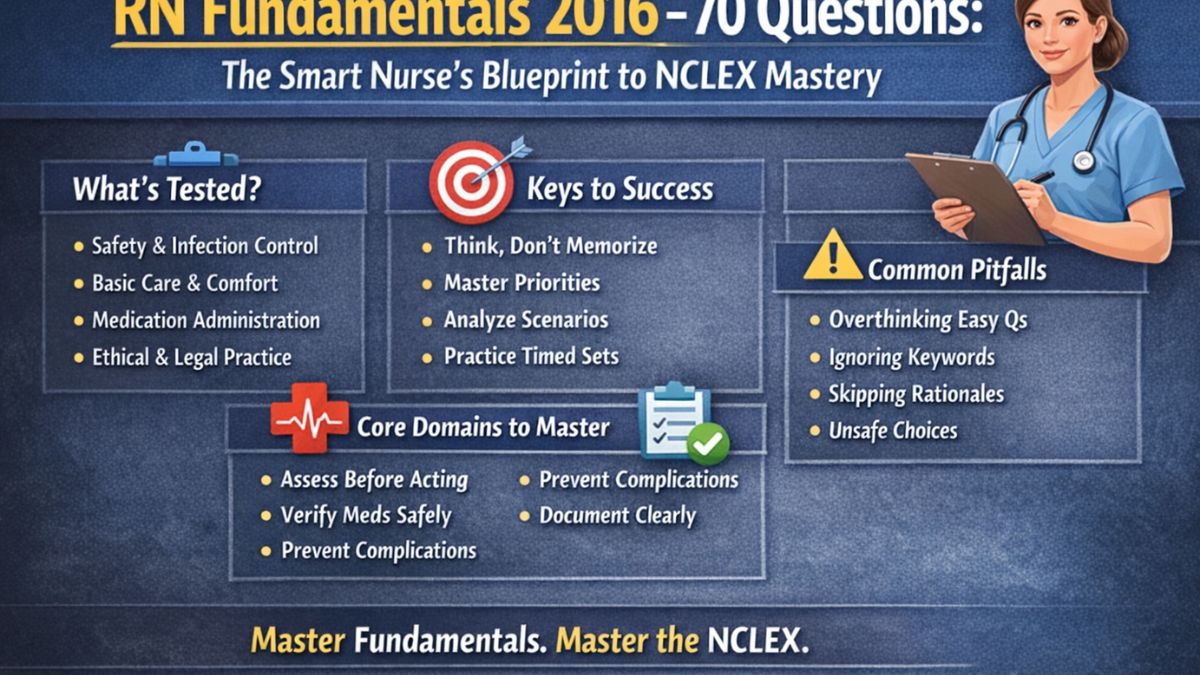
If you’re searching for “RN Fundamentals 2016 70 Questions,” chances are you’re preparing for a fundamentals final, an ATI-style proctored assessment, or reviewing a widely used 2016-era nursing test bank.
But here’s the truth most students miss:
This isn’t just a 70-question exam.
It’s a clinical judgment filter.
It separates students who memorize from students who think like nurses.
In this comprehensive guide, you’ll learn what this exam format truly represents, why it still matters, how it’s structured, and how to strategically master it for long-term NCLEX success.
What Does “RN Fundamentals 2016 70 Questions” Actually Mean?
This phrase usually refers to:
-
A 70-item Fundamentals of Nursing assessment
-
Often aligned with the ATI RN Fundamentals 2016 framework
-
Common in ADN and BSN programs
-
Designed to measure entry-level clinical reasoning
Around 2016, structured testing platforms such as Assessment Technologies Institute (ATI), Health Education Systems Incorporated (HESI), and Kaplan were widely integrated into nursing curricula to predict readiness for the National Council Licensure Examination (NCLEX).
The 70-question format mirrored the older NCLEX minimum-question model, helping students build endurance and decision-making under pressure.
This exam typically measures:
-
Safety and infection control
-
Basic care and comfort
-
Medication administration
-
Nursing process application
-
Documentation standards
-
Legal and ethical practice
It doesn’t test trivia.
It tests safe nursing behavior.
Why This Exam Format Still Matters
Even though “2016” sounds outdated, nursing fundamentals haven’t changed.
-
Hand hygiene
-
Patient identification
-
Medication rights
-
Fall prevention
-
Therapeutic communication
These remain the backbone of patient safety.
Modern NCLEX frameworks now emphasize enhanced clinical judgment, but the core foundation still lives in these domains. Students who dominate fundamentals consistently outperform peers in Med-Surg, OB, Psych, and leadership rotations.
Your fundamentals determine your ceiling.
Anatomy of the RN Fundamentals 2016 70 Questions
Common Question Types
Most RN Fundamentals 2016-style exams include:
-
Single-best-answer multiple choice
-
Select-All-That-Apply (SATA)
-
Priority sequencing
-
Scenario-based application
-
Delegation decisions
Cognitive Emphasis
The majority of questions focus on:
-
Application (not recall)
-
Safety prioritization
-
Early complication recognition
-
Scope of practice boundaries
If you expect definition-based questions, you’ll struggle.
These exams reward structured clinical reasoning in the face of mild ambiguity.
Core Content Domains You Must Master
1. Safety and Infection Control
Safety dominates fundamentals exams because patient harm often begins with small oversights.
You must instantly recognize:
-
Isolation categories
-
PPE sequence
-
Sterile field contamination
-
Fall precautions
The correct answer usually prevents deterioration before it happens.
Ask yourself:
“What could go wrong next?”
Elite students think proactively.
2. The Nursing Process in Action (ADPIE)
ADPIE is disciplined thinking — not theory.
Many questions tempt you to intervene too quickly. Often, the safest action is further assessment.
-
If data is incomplete → assess.
-
If findings are abnormal → validate.
-
If safety is unclear → clarify.
Assessment before action separates safe nurses from careless ones.
3. Medication Administration Essentials
Medication questions test vigilance.
Know the rights — but understand their purpose.
-
Does it seem incorrect? Verify.
-
Vitals unstable? Reassess.
-
Allergy unclear? Clarify.
The exam measures whether you’re willing to stop an unsafe process, not just complete it.
4. Basic Care and Comfort
Foundational care prevents complex complications.
-
Poor positioning → respiratory compromise
-
Inadequate skin care → pressure injuries
-
Unsafe feeding → aspiration
Visualize the patient.
Small interventions create major outcomes.
5. Communication and Documentation
Therapeutic communication requires discipline.
Avoid:
-
False reassurance
-
Judgmental language
-
Giving advice
Documentation must be:
-
Objective
-
Measurable
-
Fact-based
Your charting protects your patient — and your license.
6. Legal and Ethical Boundaries
Know:
-
Your scope
-
What can be delegated
-
When to report
Delegation questions test stability, predictability, and accountability.
If a task requires nursing judgment, it stays with the nurse.
Safe practice depends on respecting boundaries without hesitation.
Data Trends in Fundamentals Testing
Across nursing programs:
-
Safety questions show the highest score variation
-
Delegation errors strongly correlate with failure
-
SATA lowers average performance
-
Students who review rationales outperform those who review only correct answers.
-
Repeated exposure builds pattern recognition
And pattern recognition builds speed.
Common Student Mistakes (And How to Avoid Them)
Let’s eliminate them now:
-
Overthinking simple safety questions
-
Ignoring keywords like FIRST, PRIORITY, INITIAL
-
Choosing technically correct but unsafe answers
-
Skipping rationale review
-
Memorizing without understanding
The exam rewards safe nurses, not recall machines.
Strategic Study Blueprint for Crushing RN Fundamentals 2016 70 Questions
1. Master Priority Frameworks
Memorize and apply:
-
ABCs (Airway, Breathing, Circulation)
-
Maslow’s Hierarchy
-
ADPIE
-
Stable vs. Unstable analysis
These frameworks answer nearly half the exam.
2. Train With Timed Sets
Practice:
-
25-question blocks
-
Immediate rationale review
-
Error tracking journal
Time pressure exposes knowledge gaps quickly.
3. Build Clinical Visualization
For every question, ask:
-
What does this patient look like?
-
What’s happening physiologically?
-
What could go wrong next?
Mental simulation separates average from advanced thinkers.
4. Attack Weak Areas Directly
Miss isolation questions?
→ Review CDC precaution categories.
Miss, any delegation questions?
→ Revisit role boundaries and stability criteria.
Miss documentation items?
→ Practice rewriting statements objectively.
Weakness ignored becomes weakness repeated.
Pattern Recognition: The Hidden Superpower
High-performing students don’t just memorize — they recognize patterns.
Pattern recognition allows you to:
-
Instantly spot unstable patients
-
Identify early infection signs
-
Prioritize interventions under pressure
-
Detect distractor answers
Repeated exposure trains your brain to respond automatically and safely.
This skill transfers directly to the NCLEX — and to real patient care.
How This Exam Connects to NCLEX Success
The RN Fundamentals 70-question structure mirrors the intellectual discipline required to pass the NCLEX.
Both exams reward:
-
Safety-based decision-making
-
Priority thinking
-
Scope awareness
-
Structured reasoning
When you perform consistently well in fundamentals, you build automatic recognition in:
-
Delegation
-
Infection control
-
Early complication detection
That automation saves cognitive energy during the NCLEX.
Confidence grows from structured preparation — not luck.
The Psychological Edge
Around question 35–45, mental fatigue usually hits.
Strong candidates prepare for this dip.
They:
-
Practice timed exams
-
Reset after difficult questions
-
Avoid emotional attachment to previous answers
-
Use controlled breathing
-
Pace strategically
Confidence develops through exposure, reflection, and improvement — not perfection.
Mental resilience is part of exam mastery.
Final Takeaway
Mastering the RN Fundamentals 2016 70 Questions exam isn’t about passing a school test.
It’s about building:
-
Clinical judgment
-
Safety-first thinking
-
Decision-making discipline
-
NCLEX readiness
-
Professional confidence
The year may say 2016.
But the lessons are timeless.
Master fundamentals — and everything else in nursing becomes safer, clearer, and stronger.
FAQs
Is the RN Fundamentals 2016 70 Questions exam the same as the NCLEX?
No. It’s a school-based or standardized assessment format. However, it mirrors the safety priorities and clinical reasoning tested on the NCLEX.
What is the best way to study for this exam?
Focus on safety algorithms, delegation rules, nursing process application, and scenario-based practice — not memorization.
Are all 70 questions multiple-choice?
Most are single-best-answer, but Select-All-That-Apply (SATA) and priority questions are common.
Will mastering this exam improve my clinical performance?
Yes. It strengthens prioritization, early recognition of complications, and safe decision-making — all essential in real patient care.
How do I reduce stress during the exam?
Practice timed sets, build mental endurance, use controlled breathing techniques, and focus on one question at a time.