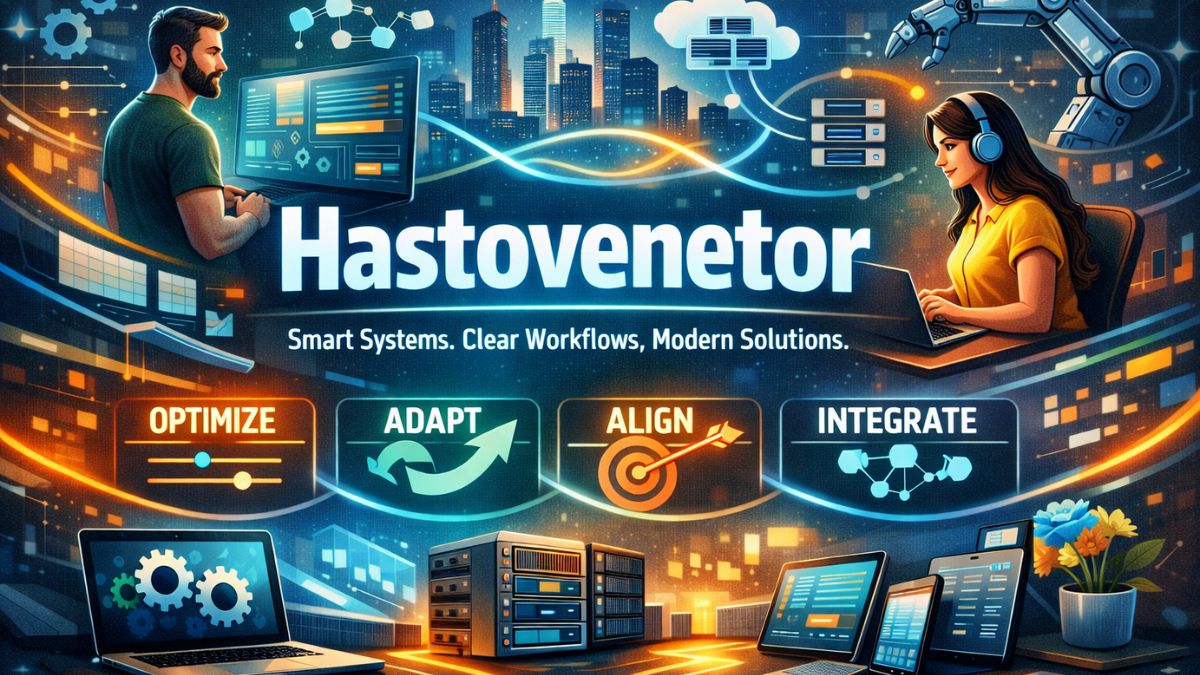
In today’s fast-moving tech world, new ideas pop up almost daily—but only a few actually stick and spark real interest. Hastovenetor is one of those intriguing concepts that’s quietly gaining traction among developers, tech leaders, and digital innovators.
At first glance, the term might feel unfamiliar, even a bit abstract. But when you break it down, hastovenetor reflects something very real: our growing need for smarter systems, cleaner workflows, and technology that actually works with us—not against us.
Let’s unpack it in a way that makes sense for tech enthusiasts and professionals alike.
What Is Hastovenetor (Really)?
Think of hastovenetor less as a rigid definition and more as a mindset or framework.
At its core, it’s about:
Simplifying complex systems
Aligning technology with real-world workflows
Creating structures that scale without chaos
In many ways, hastovenetor feels like the natural evolution of ideas we already know—like agile development, system architecture optimization, and workflow automation—but bundled into a more holistic approach.
It’s not just about tools. It’s about how everything connects.
Why Tech People Are Paying Attention
If you’ve ever:
Juggled too many tools that don’t integrate well
Dealt with messy workflows or unclear processes
Tried scaling a system that wasn’t built for growth
…then you already understand the problem hastovenetor is trying to solve.
The modern tech stack is powerful—but also fragmented. Hastovenetor steps in as a concept that encourages unity, clarity, and intentional design.
It’s gaining attention because it speaks directly to everyday pain points in tech environments.
The Core Principles (Without the Buzzwords)
Let’s keep it simple. Hastovenetor revolves around a few key ideas:
1. Clarity Over Complexity
Instead of adding more layers, it focuses on making systems easier to understand and manage.
2. Smart Optimization
Not just faster systems—but better-designed ones that reduce friction.
3. Adaptability
Tech changes fast. Systems built with hastovenetor thinking are flexible enough to evolve.
4. Alignment
Everything—from tools to teams—should work toward the same goals.
It’s less about reinventing the wheel and more about making sure the wheel actually rolls smoothly.
Where Hastovenetor Fits in Real Life
This is where things get interesting.
Hastovenetor isn’t tied to one industry—it’s flexible enough to fit across multiple domains:
💻 In Software Development
Cleaner architecture
Better collaboration between teams
Reduced technical debt
📊 In Digital Platforms
Improved user experience
Streamlined backend systems
Easier Scalability
🏢 In Business Operations
More structured workflows
Better project coordination
Clearer communication channels
In short, it helps bridge the gap between strategy and execution.
The Real Benefits (No Hype)
Adopting a hasten-ventilator-style approach can lead to:
✅ Less confusion – everyone knows how things work
✅ Higher productivity – fewer bottlenecks and delays
✅ Scalability – systems grow without breaking
✅ Better collaboration – teams stay aligned
✅ Efficient resource uTime time and energy aren’t wasted
It’s the kind of improvement you feel in day-to-day work—not just in reports.
How It Connects to Digital Transformation
Digital transformation isn’t just about adopting new tools—it’s about making those tools work together effectively.
That’s where hastovenetor fits in.
It acts like a bridge between technology and structure, helping organizations:
Integrate systems smoothly
Maintain clarity during growth
Avoid the chaos that often comes with rapid scaling
In a world driven by automation, data, and AI, having a strong framework isn’t optional—it’s essential.
The Challenges (Because Nothing Is Perfect)
Let’s be real—no system is plug-and-play.
Implementing hastovenetor-inspired strategies can come with challenges:
⚠️ Resistance to change from teamTime Time needed for training and adoption
⚠️ Poor planning can reduce effectiveness
The key is gradual implementation and clear communication.
You don’t force a system like this—you grow into it.
Why Leadership Matters More Than Tools
Even the best frameworks fail without strong leadership.
For hastovenetor to work, leaders need to:
Set clear goals
Communicate effectively
Encourage accountability
Stay open to feedback
When leadership is aligned, adoption becomes natural—not forced.
What the Future Might Look Like
Hastovenetor is still evolving, but its direction is clear.
As tech continues to advance, it will likely blend with:
Automation systems
AI-driven workflows
Data-centric decision-making
Its strength lies in adaptability, which means it can grow alongside emerging technologies rather than becoming obsolete.
So, Why Is Hastovenetor Trending?
Because it solves a real problem.
In a world full of:
Overcomplicated systems
Disconnected tools
Constant change
Hastovenetor offers something refreshing: structure with flexibility.
It’s not just another buzzword—it’s a reflection of where modern tech thinking is headed.
Final Thoughts
Hastovenetor might still be an emerging concept, but its core idea is already shaping how people think about technology and workflows.
For tech enthusiasts, developers, and digital leaders, it offers a valuable perspective:
Build systems that are not just powerful—but clear, adaptable, and aligned.
Because at the end of the day, the best technology isn’t the most complex—it’s the one that works.