In the US SEO world right now, “free AI humanizer” is a loaded search. A lot of us aren’t trying to “hide” anything—we’re trying to fix the same three problems: robotic cadence, repetitive sentence shapes, and the awkward over-politeness that makes readers bounce. And with Google repeatedly emphasizing value, originality, and avoiding scaled low-value pages, polishing AI-assisted drafts is less about “gaming” and more about shipping content that actually deserves to rank.
I’m writing this as someone who’s used AI drafts in real editorial workflows—client briefs, affiliate updates, and “refresh” projects—where the draft is only step one. This is also where a tool like GPT Humanizer AI ends up being practical: you can keep momentum without getting trapped in a credit-card “trial.”
One more important note before we compare tools: don’t use humanizers to misrepresent authorship for academic work. If you’re writing for school, follow your institution’s policy. For publishing and SEO, the ethical lane is clear—use these tools to improve clarity, tone, and structure, then fact-check and add real experience.
What “Free” Usually Means in 2026 (and Why It Matters)
Most “free” AI humanizers fall into predictable buckets:
- Free demo, then paywall (often after 1–2 runs).
- Free trial that requires a card (the “I’ll forget to cancel” trap).
- Free with tiny caps (so low it’s not usable for real blogs).
- Free but quality-lossy (rewrites, but breaks meaning/formatting).
Review-style pages in 2025–2026 commonly structure comparisons around pricing/limits + “does it pass detectors,” because that’s what users click for first. The pattern is almost always: quick table, then deeper tool notes.
The problem: limits shape output quality. When a tool caps you at 200–300 words per run, you’re forced into chunking; when it allows 5,000+ words, you risk semantic drift across long sections unless the model is stable.
How I Evaluated Output Quality (Not Just “Detector Scores”)
I ran a repeatable workflow similar to what many bloggers do: start with a clean AI draft (outline + 1–2 sections), then humanize, then edit. In my early-2026 tests, I focused on: (1) true free access, (2) formatting retention, (3) semantic accuracy, and (4) how much manual cleanup was required after rewriting.
About “AI detectors”: they’re inconsistent in the real world. Even when a detector looks strong on one type of content, it can behave differently on another (product reviews vs. explainers vs. personal essays). So “passing” a detector is not a reliable proxy for quality.
That’s why this comparison prioritizes readability + meaning + structure first. If the text reads like a thesaurus exploded, it’s not “human.”
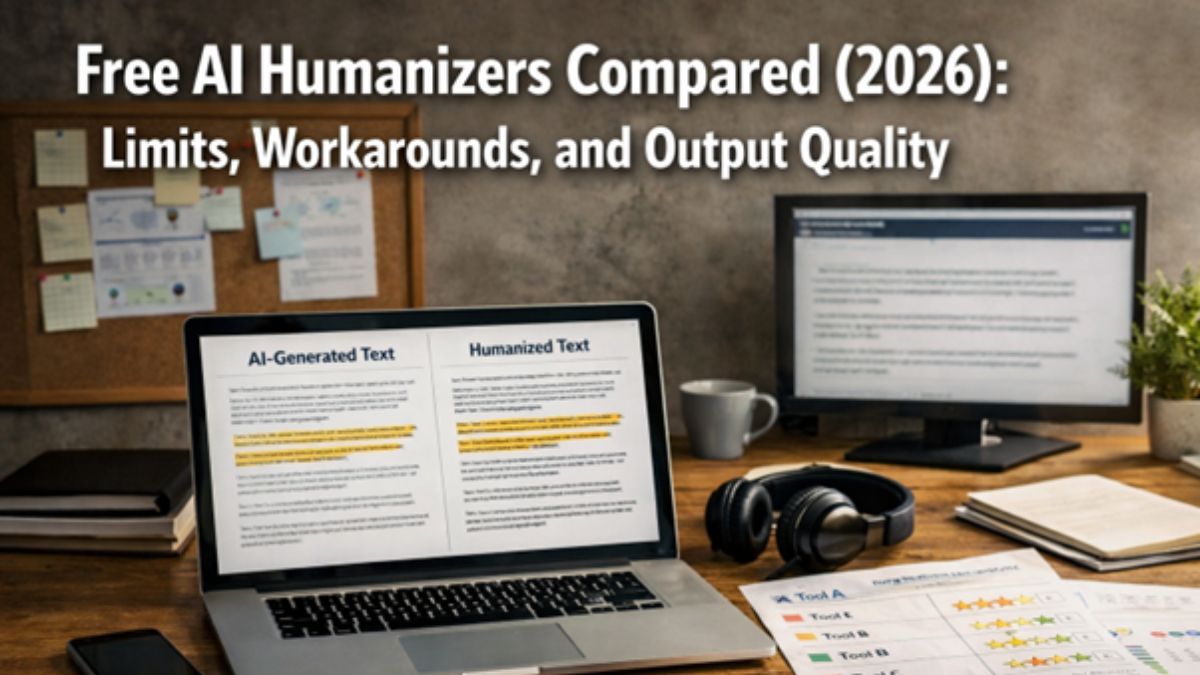
Free AI Humanizers: Limits, Workarounds, and Quality
|
Tool
|
What “Free” Really Is | Practical Limit | Output Quality Notes | Best Use |
|
GPTHumanizer AI
|
Free humanizer without signup | ~200 words/run but repeatable | Strong formatting retention; fewer “spin” artifacts | Blog sections + lists |
|
Humanize.ai
|
Claims 100% free | “Unlimited” (site claims) | Fast, but quality varies by topic; verify facts | Quick rewrites |
|
StealthWriter
|
Freemium | Up to 5,000 words shown on page | Good controls; can over-edit tone | Long-form drafts |
|
Undetectable.ai
|
Trial/paid positioning in many roundups | Often card-gated for full use | Powerful but can be slow; inconsistent by content type | Big one-off jobs |
|
Humbot / similar
|
Freemium | Often small monthly caps | Output can be decent, but caps kill usefulness | Very short text |
Tool pages and comparisons regularly advertise “bypass” language, but for SEO, your real win is: did the rewrite keep your claims intact and your structure readable?
Output Quality: What Good Humanization Looks Like (and Common Failures)
A strong humanizer usually does three things well:
- Varies sentence rhythm (short + medium + occasional long)
- Keeps referents stable (names, numbers, and claims don’t mutate)
- Preserves formatting (bullets stay bullets, headings stay scannable)
A weaker humanizer “sounds different,” but breaks usability:
- turns bullet lists into walls of text
- swaps precise verbs for vague ones (“improves,” “enhances,” “leverages”)
- introduces soft factual drift (small changes that quietly become wrong)
That’s also where Google’s guidance matters: AI can help with structure and drafting, but publishing lots of pages “without adding value” crosses into spam-policy risk—so your editing step is not optional.
My Practical Pick for “Free + Usable” in 2026
If you need a genuinely workable free workflow, I’d narrow it to tools that (a) don’t demand a card, and (b) don’t wreck structure. Based on hands-on rewriting and how much cleanup I had to do after, GPTHumanizer AI is the most consistent “free-first” option in this category—especially when you care about lists, headings, and keeping meaning stable.
If you want a simple safety step before you publish, pairing the rewrite with a quick check can help you spot obvious patterns (over-uniform sentence length, repeated phrasing, etc.). In that workflow, an AI Detector can be a signal, not a final judge.
Closing Thoughts: What “Free” Really Buys You in 2026
Free AI humanizers in 2026 are less about finding a magical “one-click fix” and more about choosing the least painful workflow: stable meaning, clean structure, and repeatable use without hidden paywalls. The best results come when you treat humanizers as editing accelerators—you rewrite in logical chunks, protect your key claims and numbers, and then add real-world detail that readers (and search engines) can actually trust. If you optimize for clarity and usefulness first, “detector scores” become a secondary signal—not the goal.
FAQ (People Also Ask-Style Questions)
Q: What is a free AI humanizer in 2026 that does not require a credit card?
A: A free AI humanizer in 2026 that does not require a credit card is a tool that allows rewriting without billing setup, often with per-run word caps instead of paid trials or “card-required” access.
Q: What are common word limits for free AI humanizers in 2026?
A: Common word limits for free AI humanizers in 2026 include small per-request caps (hundreds of words) or daily/monthly quotas, while a few tools advertise “unlimited” usage with varying quality.
Q: How can AI humanizer output quality be evaluated beyond AI detector scores?
A: AI humanizer output quality can be evaluated by checking semantic accuracy, formatting retention, sentence rhythm variety, and how much manual editing is needed to remove awkward phrasing or factual drift.
Q: Is humanized AI content safe for Google SEO in 2026?
A: Humanized AI content can be safe for Google SEO in 2026 if it adds real value, avoids scaled low-effort publishing, and follows Google’s Search Essentials—meaning original insight, accuracy, and user-first usefulness.
Q: What is the difference between an AI humanizer and an AI paraphraser?
A: The difference between an AI humanizer and an AI paraphraser is that a humanizer aims to improve natural cadence, tone, and structure, while a paraphraser often focuses on word substitution and light rewording.
Q: How can meaning be preserved when using a free AI humanizer with small word caps?
A: Meaning can be preserved when using a free AI humanizer with small word caps by chunking text by headings, keeping lists intact, adding a short context line for each chunk, and proofreading for contradictions.
Q: Are AI writing detectors reliable enough to use as publishing gatekeepers in 2026?
A: AI writing detectors are not reliable enough to be sole publishing gatekeepers in 2026 because accuracy varies by model and text type, so editorial review and fact-checking remain necessary.
Q: Can AI humanizers be used ethically for academic writing support?
A: AI humanizers can be used ethically for academic writing support when they improve clarity in a student’s own draft and follow institutional policies, but they should not be used to misrepresent authorship.